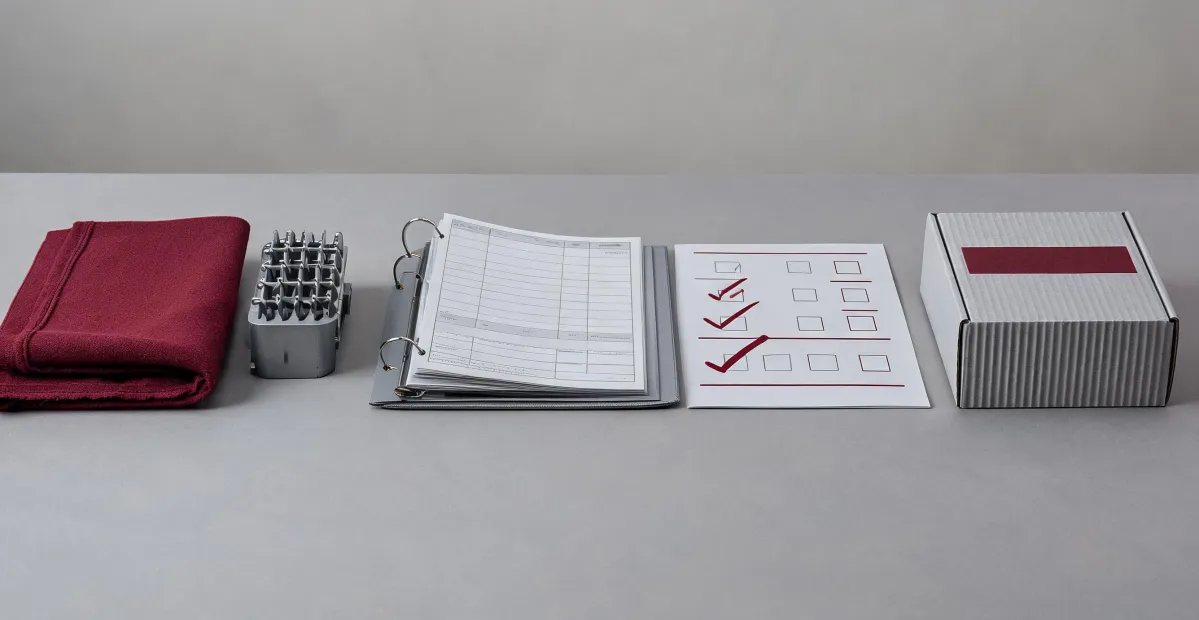
The only warning in this sauna tent's instruction manual that names a physical injury has nothing to do with heat, steam, or electricity. It is about assembly. Every pole, every connector, and the insulated cover itself has to be locked down before the tent is used, and improper assembly may cause the structure to collapse, leading to potential injury. That one sentence reorders the rest of the document. Read as a build sequence, the manual is finished when the frame stands up. Read as three checks that fail in different ways, it is finished only when the steamer's own instructions are in your hand.
Scope first: this is the nurecover Tropic Home Steam Sauna, and what follows tracks its manufacturer's instruction manual. No independent clinical or measured test report on this model is available to check against, so performance questions about this tent cannot be settled here. The manual speaks to construction, operation, and warnings, and that is the boundary of what it supports.
On Day One, Check the Frame Before the Steam
Day one is a frame day, not a steam day. The assembly requirement reads: "Ensure all poles, connectors, and the sauna cover are securely fastened before use. Improper assembly may cause the sauna structure to collapse, leading to potential injury." Three objects sit inside that sentence. Poles are the long struts; connectors are the joints where struts meet; the cover is listed alongside them, which puts covering in the same category as fastening rather than finishing.
"Before use" sets the deadline at the first steam, not at the first wobble you notice. A connector that is only half seated can hold while the tent sits empty and cold. Once the cover is under tension and a running steamer is putting moisture into the fabric, the load on that joint changes direction, and a joint that was never fully seated has less margin than one that was. That deadline is why the check is worth doing while the tent is cold, rather than after the first session tells you something feels off.
What the requirement does not hand you is a number. No torque figure, no insertion sequence, no pass-fail test appears in it, so anyone quoting a specific tightness for this frame is inventing one. If you want that detail, ask the seller whether a fastening order or a tightness value is specified for the Tropic frame before you build. The instruction itself is not optional; that wording is the manufacturer's, and it is the one line here you cannot soften.
Drape the Cover Over a Frame That Is Already Fastened
Once the frame passes, the cover goes on. The instruction is to "carefully drape the insulated sauna cover over the assembled sauna frame," and two words carry the weight: assembled and carefully.
Over the assembled frame is a sequencing condition, not a description. The cover goes on second, which turns fit into a field check on the frame itself. If a panel pulls to one side, a seam sits off-center, or one wall hangs slack while the others are taut, suspect a pole that has not dropped fully into its connector before you blame the fabric. You are reading the cover as a gauge.
Carefully is the other half. Dragging an insulated cover across connector tips pushes joints sideways, and those joints are shaped to hold under compression, not to survive a tug across their ends. Lift the cover, place it, let it settle, then re-walk the fastening points. Treat the cover as part of the same pre-use list as the poles, and it gets the same treatment.
The payoff is practical rather than dramatic: one pass around the tent, no tools, repeatable in the time it takes to walk the perimeter. A loose joint caught while the tent is empty and cold is a small correction. The same joint caught mid-session is the situation the warning describes.
Why the Steamer Instructions Are in a Different Box
The steamer gets one sentence: "Set up the steamer. Refer to the separate steamer box for set up instructions." That is a handoff, not a step. The tent manual's coverage stops at frame and cover, and the half of the system that actually makes steam is documented in a second document that ships in a different box.
Reading this as a buyer rather than a builder, I would open the steamer's own sheet first on arrival and treat the tent manual as the second read. Coverage is lopsided: the tent manual can be read end to end and still leave you with nothing to follow at the moment you switch the steamer on, so the sheet is the one that can actually block you. That preference is narrow. It holds for this model and only up to the first switch-on; if your job is comparing this tent's frame and fabric against another option before buying, skip it, because the tent manual is the whole document that job needs.
Two questions are worth settling on arrival day, while the boxes are open. Does the steamer box contain its own set of instructions, and do those instructions name the same model you received? Both take a minute to answer, and both matter because the tent manual offers no fallback for that step.
No steamer setup detail appears in this article, and that is deliberate. Filling, wiring, and timing belong to a document this one does not contain; writing them here would be guesswork dressed as procedure, and a reader following invented steps is worse off than a reader who knows to go find the real sheet.
The First Week Is a Repeat, Not a New Test
By the end of the first week, the useful habit is repetition rather than invention. The requirement is stamped before use; the manual does not say after every session, and nothing in the saved text resets the check once the tent has run. So the supported practice is to walk the same three points in the same order, poles then connectors then cover, each time before you steam.
What changes across that week is the tent's history, not the checklist. Imagine a cover tugged while you climb in, a frame nudged when the room gets rearranged, a connector worked loose under the cover's pull. None of that shows up in the fabric. It shows up at the joint, which is why the repeat starts there.
Suppose the tent sits in a hallway, or in a room where a child or a dog passes it daily, or you move it between rooms every so often. Under those conditions the repeat earns more of its keep, because the frame is absorbing sideways contact that a before-use assembly check never contemplates. That is a scenario, not a test result: it tells you when to slow down, not what will happen.
What the first week cannot tell you is whether the walk is still finding anything, or whether it has become a formality. A tent that feels solid on day seven is evidence about your assembly and nothing else; the check earns its keep in month three, when the tent is familiar enough that skipping it feels harmless.
A Month In, the Same Three Checks Still Apply
A month later, the three checks are still the three checks. They are operating requirements rather than break-in steps, so familiarity does not retire them; what changes is that the sequence starts taking less attention than it did on day one, which is exactly the point at which a step quietly gets skipped.
What stays open at one month is what this document was never built to answer. How much heat the insulated cover retains, how the fabric and joints hold up across repeated heating cycles, what the steamer costs to run: no independent clinical or measured report exists to settle any of it, and the manual's stated scope is construction, operation, and warning. A number attached to any of those would be fabricated, however plausible it sounded.
One low-cost habit keeps the arrangement working: store the tent manual and the steamer sheet together, in the tent bag if they fit, so the pair survives the week the cardboard leaves the house. Losing the steamer sheet is the failure that costs you most, because it is the one document here with no substitute.
What you get from reading the manual this way is a check you can run in a few minutes before each session and an accurate sense of where the document stops. What you give up is the convenience of one manual and one assembly: the assumption that the box you open contains the whole procedure, and any expectation that a construction document can settle a performance question.
